
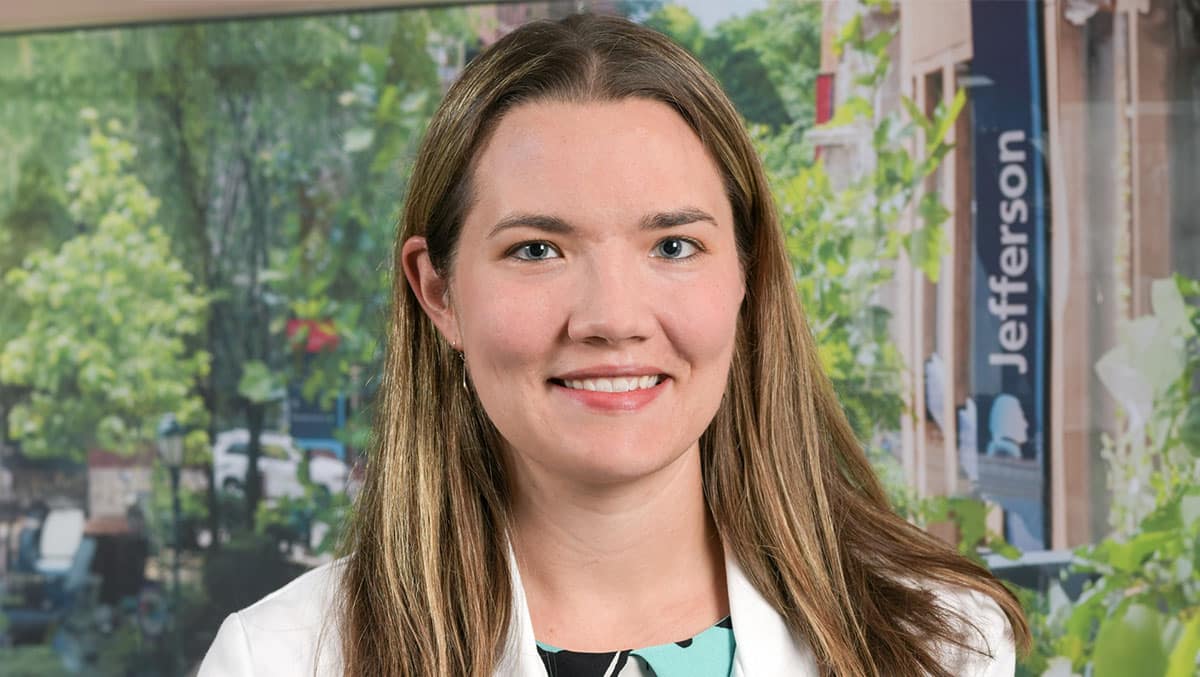
Lauren Delaney, 38
Lauren Delaney is advancing ultrasound-triggered therapies that deliver antibiotics directly to orthopedic implant infections.
Personal experiences with family members facing health challenges was an early spark that drew biomedical engineer Lauren Delaney to cutting-edge research on how to prevent and treat devastating orthopedic infections. As an undergraduate and doctoral student at Drexel, she found more inspiration through co-ops and labwork, which laid the foundation for her current projects on ultrasound-triggered antibiotic delivery for spinal fusion surgeries and biofilm eradication on implanted joint devices. To understand how her work translates in practice, consider an infected knee replacement. A surgeon typically debrides the area. Delaney adds a novel enhancement to the standard of care: the patient receives, by injection, a mixture of antibiotics and microbubbles. Then ultrasound pressure waves burst the bubbles, a procedure that disrupts any bacteria still adhering to the implant while also blasting the area with antibiotics to prevent a recurrence of infection. Excitingly, Delaney will lead a multi-site clinical trial beginning this year under a $3.8 million National Institutes for Health grant that she won — a big accomplishment for an early-career scientist. Her spinal fusion project is at an earlier stage but takes a similar approach. A hydrogel, “almost like creating a Jell-O mold,” she explains, packed with antibiotics and microbubbles is implanted into the spine at the time of fusion surgery to supplement standard-of-care antibiotics. A couple of days later, the ultrasound is used to burst the bubbles and release this second wave of antibiotics, helping to stave off infection.
“I feel ultrasound is an underused modality. We’re still learning all of the potential you could get out of this readily available machine in most hospitals and imaging clinics.” Lauren Delaney
In 2024, Delaney won the American Institute of Ultrasound in Medicine’s Great 8 competition for the best abstract at that year’s conference, from among hundreds. The group also recognized her in 2025 with its New Investigators award. In 2024, Delaney received the Drexel Biomed Distinguished Alumni Award from her college. Already, she has 29 publications in peer-reviewed journals, including top journals Radiology and Biomaterials, and 78 abstracts. “At the heart of it,” she says, “I hope to keep making a tangible difference for patients and improving the care available to them.”
In her own words…
My Greatest Accomplishment:
Successfully advancing, from pre-clinical evaluations to a National Institutes of Health-funded multi-site clinical trial, our innovative treatment for infections in knee replacements. Reaching this stage reflects not only the dedication and expertise of our research team but also the successful translation of an innovative approach from benchtop development, through preclinical validation, and now into clinical evaluation.
How Drexel Shaped My Path:
As an undergraduate, I concentrated in biomaterials and tissue engineering and completed my co-ops in orthopedic implant failure analysis. For my PhD, I shifted to the opposite end of the research pipeline, from the end-stage failure analysis to the beginning-stage benchtop development of microbubbles made from polymers that could carry chemotherapy drugs. These combined experiences — orthopedics, biomaterials and ultrasound-mediated drug delivery — came together serendipitously. Drexel gave me the freedom to explore what mattered to me, and in doing so, helped me find the path I’m on today.
Where I Hope To Be in Five Years:
I hope to continue driving innovative solutions for challenging health problems, especially surgical site and orthopedic implant infections. More specifically, I hope for our clinical trial to demonstrate significantly improved outcomes for our patients. If successful, I intend to expand this work to include hip and shoulder joint replacement infections and to adapt similar ultrasound-triggered therapies for use in primary joint-replacement surgeries. DM


