
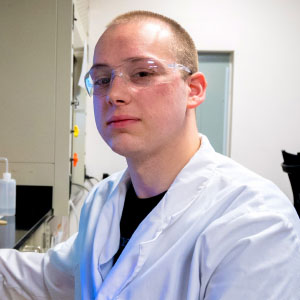
Tucker Collins
College of Medicine graduate student Tucker Collins’ interest in neuroscience isn’t merely academic...he is also on the autism spectrum.
Tucker Collins transferred to Drexel after one year at Georgetown University in search of a stronger science program; but he found something even more important: A growing awareness of himself as a person with Asperger’s Syndrome.
Asperger’s is a high-functioning variant of autism spectrum disorder, which includes a range of conditions around social skills, repetitive behaviors, speech and nonverbal communication. The disorder “fundamentally alters individuals’ abilities to interact and communicate,” according to the A.J. Drexel Autism Institute.
Despite the challenges, Tucker thrived in his Drexel years, graduating summa cum laude with a degree in neurochemistry from the Custom Design Major Program run by the Pennoni Honors College, while also taking on a role as an energetic advocate for the autism community.
Academic life was not without its hurdles. “My challenge is with writing. I take tests very well so I have never gotten disability accommodation, but it’s harder to put words together to make sense, to get the idea out of my head and onto a computer screen,” he says. “I will word something one way and then go back and rewrite many times over, which ends up making things take a lot more time.”
In meeting such challenges, Tucker found support outside of his biological family through a unique relationship. When he was 17, he met Amber Dorko Stopper and Benjamin Levin and their children through a babysitting job. Stopper’s father also had Asperger’s and when she realized that Tucker had never been diagnosed or treated, much less understood by his biological family, she and her husband began helping him to learn more about the condition.
When he transferred to Drexel, the couple was able to assist him with key decisions through the Family Education Rights and Privacy Act, which permits students to share information with designated support persons other than parents, and they invited him to move in with them while he attended college.
“I felt that Tucker might need some support rather than criticism,” Stopper recalled in an article she and Tucker co-wrote about their relationship for the Organization for Autism Research. “In 2013, he became a member of our household, though we had already long considered him family.”
Tucker went on to win a scholarship from the Drexel Autism Support Program in 2016, and while an undergraduate he worked on a number of projects to engage the community on autism issues. In one instance, he worked with the A.J. Drexel Autism Institute to bring the autism-inspired comedy troupe Asperger’s Are Us to campus.
Why a comedy show? “It brings attention to the fact that having a disability doesn’t mean that someone is incapable,” he says. “These guys tour all the time, they have toured Europe and they are doing really well for themselves. They are all on the autism spectrum, but it’s not about being disabled by it. That’s not how they feel — and it’s not how I feel.”
He’s currently working with music school School of Rock Philadelphia to create a one-week summer program for kids and adults on the autism spectrum, and he has an eye toward a future in which people with autism find readier acceptance in mainstream employment.
Employment is a big issue in the autism community: People on the spectrum often stumble in job interviews and they can struggle on the interpersonal front. Inspired by Tucker’s efforts, Levin and Stopper founded Ninja Goat Nutritionals, a local firm that hires heavily in the autistic community. The company recently launched Try It Aut, a subscription services that delivers tactile stimuli — soft brushes, putty, orange-scented pumice soap — as a way to encourage personal growth and stimulate discussion for those on the spectrum.
Tucker is now pursuing a master’s degree in Drexel’s College of Medicine, where he’s doing neuroscience research, looking at the chemical processes by which the brain interprets life experience.
“We have learned more about the brain in the last few decades than we learned in the 200 years before that,” he says. “But we still have a long way to go.” — Adam Stone


