
Skyless Games
The trio behind Skyless Game Studios are building video games that fight corruption, encourage child welfare, improve multinational cultural relationships, and more — all “for a better tomorrow.”
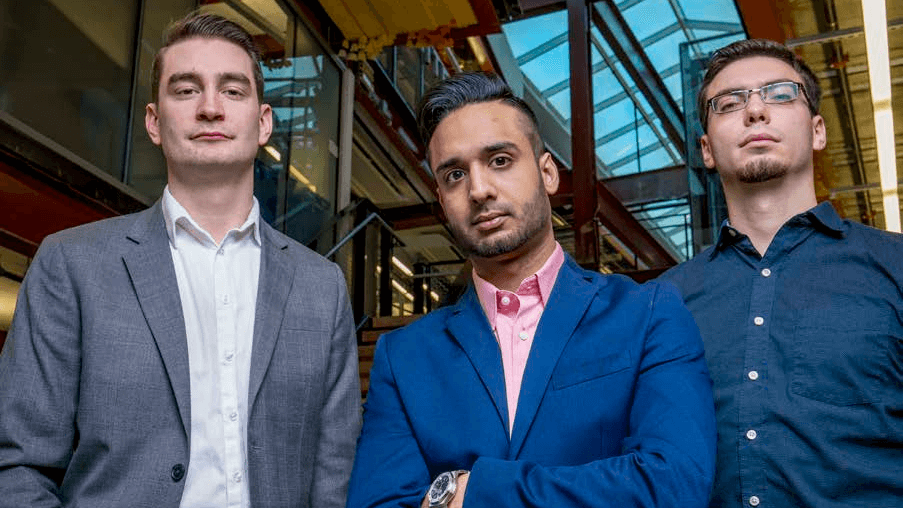
Five years ago, Chris Bennett ’12, Arad Malhotra ’13 and Oleks Levtchenko ’12 hunkered down in a conference room in Drexel’s Baiada Institute for Entrepreneurship, part of the Close School of Entrepreneurship.
“We basically made a brainstorming word cloud on a white board,” says Bennett, 27, who has a bachelor’s degree in marketing and entrepreneurship.
Even though no one remembers the exact words anymore, the cloud likely included technology, games and philanthropy. The result was Skyless Game Studios, an intriguing tech startup that creates customized video games to support a client’s cause.
“We work with organizations, nonprofits and social enterprises that are trying to make some positive difference in the world and trying to change the way people think about problems,” says Bennett, now CEO of the Philadelphia-based company.
The co-founders say they have had an interest in philanthropy since college.
Bennett and Levtchenko belonged to Pi Kappa Phi social fraternity and supported its work with disabled schoolchildren.
“We wanted to give as we grow,” Malhotra, also 27 and chief technology officer, says of the mission. He studied computer science with a focus on video game development and human computer interaction.
Video games (and virtual and augmented reality down the road) were an obvious route for the team. “I’ve done programming since I was 13,” Malhotra says. “Video games were a perfect outlet for me.”
Levtchencko, 27 as well with a bachelor’s in entrepreneurship and finance, points out that people often learn better by doing than by simply reading a bunch of facts.
“That’s what these games are — digital apprenticeships,” says Levtchencko, who formerly served as director of finance for Skyless. He now lives in Atlanta and serves on the company’s board.
Take their project “Follow the Money.” It was designed for the Repatriation Group, a nonprofit that helps developing countries fight corruption and financial crimes. Users investigate a virtual crime and learn evidence gathering, asset forfeiture and more and are scored on the type of charges pursued and assets recovered.
Their LifeLeap project supports the mission of Aahana, a nonprofit that works in India with women and children. Players accumulate points by maneuvering a character around obstacles and collecting medical supplies. Facts about the welfare of women and children — 32.7 percent of the Indian population live on less than $1.25 a day, for example — appear on screen, along with prompts to donate. An in-game store allows players to purchase coins that power the character and proceeds help Aahana buy real-world medical supplies.
Other games address topics such as the political divide in the United States via satire, as well as issues like cultural relationships, city management and autism.
Around the world, Malhotra says, people spend three billion hours a week playing video games. That’s a lot of opportunity.
“Games should not just be an end product, something for entertainment,” he says. “Games should be leveraged as a platform, as real, quantifiable social impact.” — Lini S. Kadaba


